



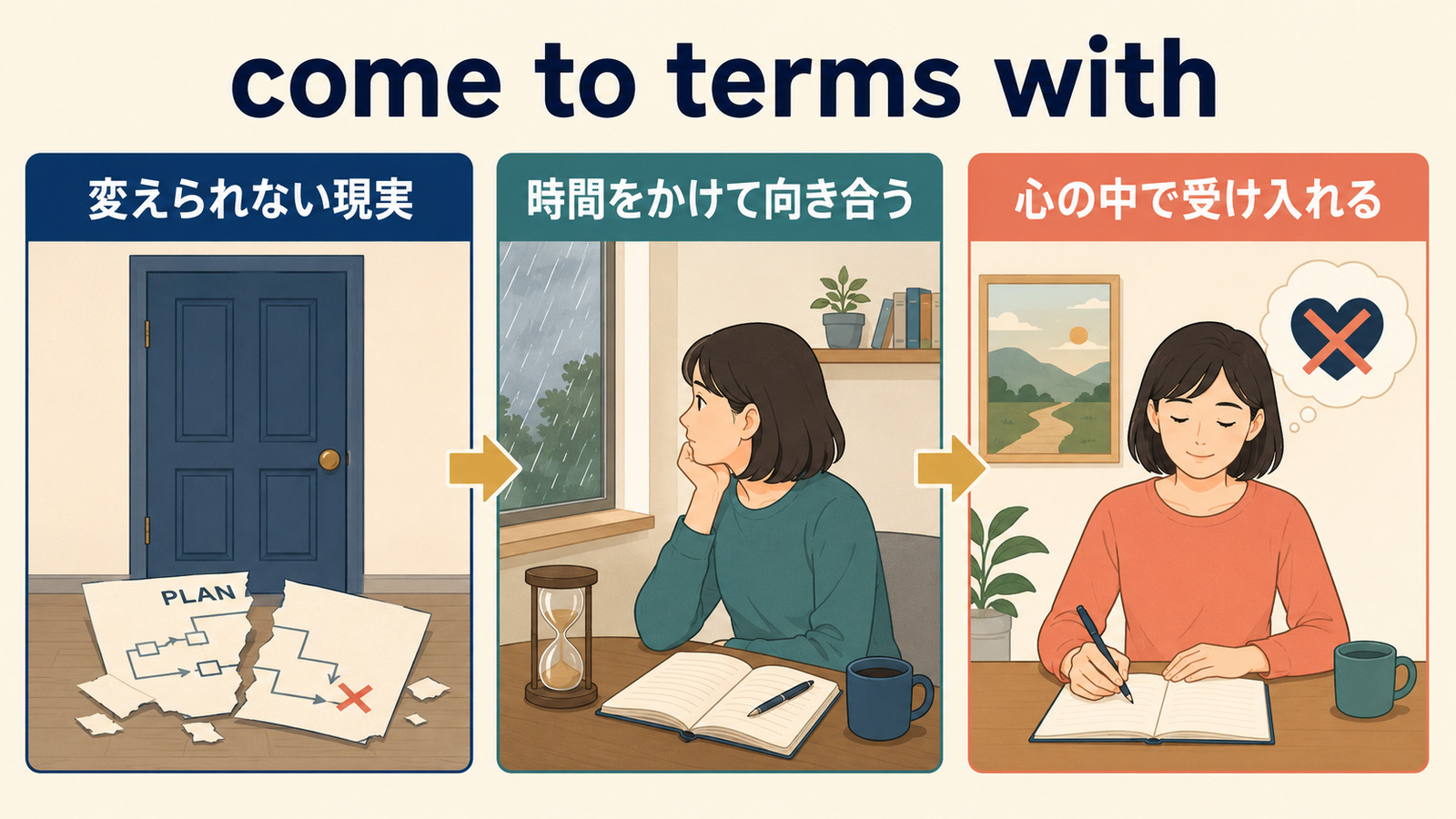
come to terms with は、つらい事実や変えられない現実を「受け入れる」「折り合いをつける」という意味の英語表現です。
She is still coming to terms with the loss. なら、「彼女は今もその喪失を受け入れようとしている」という意味です。単に頭で事実を理解するだけではなく、驚き、悲しみ、悔しさなどを抱えながら、時間をかけて心の中で受け止めていく過程を表します。
accept、face up to、get over なども日本語では「受け入れる」「乗り越える」と訳されますが、焦点は同じではありません。この記事では、terms がなぜ「条件」ではなく「折り合い」の意味になるのか、自然な語順、よく使う時制、似た表現との違いまで例文で整理します。
Contents
- 1 come to terms withの意味とニュアンス
- 2 なぜcome to terms withで「折り合いをつける」になる?
- 3 基本の語順:come to terms with+名詞
- 4 coming to terms withがよく使われる理由
- 5 日常会話・仕事で使える自然な例文
- 6 come to terms withとacceptの違い
- 7 come to terms withとface up toの違い
- 8 come to terms withとdeal withの違い
- 9 come to terms withとget overの違い
- 10 come to terms withとmake peace withの違い
- 11 reconcile oneself toとの違い
- 12 「合意する」のcome to termsとの違い
- 13 日本人が間違えやすいポイント
- 14 難しければ簡単な英語で言い換えよう
- 15 関連表現
- 16 まとめ:come to terms withは現実と心の折り合いをつける
come to terms withの意味とニュアンス
come to terms with は、望んでいなかった結果や、今さら変えられない状況を現実として認め、心の中で折り合いをつけるときに使います。
- 大切な人や物を失ったことを受け入れる
- 別れや失敗を受け止める
- 病気・年齢・身体の変化と向き合う
- 計画が実現しない現実を認める
- 自分の過去や弱さを受け入れる
ポイントは、受け入れたくなかったものが前提にあることです。好きになる、正しいと認める、賛成するという意味ではありません。「変えられないなら、その現実を抱えたまま次へ進もう」と心を調整する感覚です。
| 含まれやすい感覚 | 含まれないこと |
|---|---|
| 時間をかけた心理的な受容 | その事実を好きになること |
| 現実との折り合い | 相手の意見に賛成すること |
| 葛藤を経て前へ進むこと | すぐに忘れること |
| 変えられないものを認めること | 何も感じなくなること |
なぜcome to terms withで「折り合いをつける」になる?
terms には「条件」という意味があります。交渉で双方が条件に同意できれば、両者は同じ土台に立ち、争いを終えられます。come to terms はもともと「条件について合意に至る」という発想を持ちます。
そこから、相手ではなく現実や感情を with の後ろに置くと、「その現実と心の中で条件を調整し、折り合える地点へ来る」という比喩になります。
- come:ある状態へ至る
- terms:折り合える条件・関係
- with:向き合う対象と一緒に
- come to terms with ~:~と折り合える心理状態へ至る
 しゅみすけ(大山俊輔)
基本の語順:come to terms with+名詞
基本形は次のとおりです。
人 + come to terms with + 受け入れる対象
- He came to terms with his past.
彼は自分の過去を受け入れました。 - She is coming to terms with the change.
彼女はその変化を受け入れようとしているところです。 - We need to come to terms with reality.
私たちは現実を受け入れる必要があります。
with は前置詞なので、後ろには名詞、代名詞、動名詞、名詞節を置きます。
- with the decision:その決定を
- with it:それを
- with being alone:一人でいることを
- with what happened:起きたことを
come to terms with the fact that+文
「~という事実を受け入れる」と具体的に述べるときは、come to terms with the fact that + 主語 + 動詞 がよく使われます。
- I had to come to terms with the fact that the plan would never work.
その計画は決してうまくいかないという事実を受け入れなければなりませんでした。 - She is coming to terms with the fact that her children have grown up.
彼女は子どもたちが成長したという事実を受け入れようとしています。 - He finally came to terms with the fact that the relationship was over.
彼はその関係が終わったという事実を、ようやく受け入れました。
that 節を直接 with の後ろに置くより、the fact that を挟むのが自然です。
- ○ come to terms with the fact that she left
- △ come to terms with that she left
coming to terms withがよく使われる理由
come to terms with は、一瞬の判断よりも受容までの過程を表すため、進行形の be coming to terms with がよく使われます。
- I’m still coming to terms with what happened.
私は今も、起きたことを受け入れようとしているところです。 - They are slowly coming to terms with the changes.
彼らはその変化を少しずつ受け入れつつあります。 - She’s having trouble coming to terms with the diagnosis.
彼女はその診断結果を受け入れるのに苦労しています。
still、slowly、finally、gradually など、時間の経過を示す語と相性がよい表現です。
| 形 | 焦点 | 例 |
|---|---|---|
| came to terms with | 受容に至った | He finally came to terms with it. |
| is coming to terms with | 今、受容の途中 | She is coming to terms with it. |
| has come to terms with | 受容して今に至る | He has come to terms with his past. |
| can’t come to terms with | どうしても受け入れられない | I can’t come to terms with the loss. |
日常会話・仕事で使える自然な例文
恋愛・人間関係
- I’m still coming to terms with the breakup.
私は今もその別れを受け入れようとしているところです。 - It took him months to come to terms with the end of the relationship.
彼がその関係の終わりを受け入れるまでには何か月もかかりました。 - She has come to terms with the fact that they want different things.
彼女は、二人が望んでいるものは違うという事実を受け入れました。
仕事・キャリア
- We need to come to terms with the fact that the market has changed.
市場が変化したという事実を受け入れる必要があります。 - He struggled to come to terms with losing the promotion.
彼は昇進を逃したことを受け入れるのに苦労しました。 - The team is slowly coming to terms with the new structure.
チームは新しい体制を少しずつ受け入れています。 - I’ve come to terms with the decision, even though I don’t agree with it.
賛成はしていませんが、その決定は受け入れました。
最後の例のように、受け入れることと賛成することは別だとはっきり示せます。
家庭・人生の変化
- My parents are coming to terms with getting older.
両親は年を取ることを受け入れつつあります。 - She came to terms with selling the family home.
彼女は実家を売ることに気持ちの整理をつけました。 - It takes time to come to terms with a major change.
大きな変化を受け入れるには時間がかかります。
失敗・自分自身
- I had to come to terms with my own limitations.
私は自分の限界を受け入れなければなりませんでした。 - He has finally come to terms with his mistake.
彼はようやく自分の間違いを受け入れました。 - She is learning to come to terms with who she is.
彼女はありのままの自分を受け入れることを学んでいます。
come to terms withとacceptの違い
accept は最も広く使える「受け入れる」です。提案、謝罪、仕事、支払い方法などにも使えます。come to terms with は、感情的に難しい現実を時間をかけて受容する場面に限られます。
- She accepted the job offer.
彼女はその仕事のオファーを受けました。 - She came to terms with losing her old job.
彼女は以前の仕事を失ったことを受け入れました。
簡単に言い換えたいときは accept を使えますが、come to terms with のほうが葛藤や時間の経過を強く感じさせます。
come to terms withとface up toの違い
face up to は、避けていた問題や現実から目をそらさず、正面から向き合うことです。come to terms with は、向き合った後に心の中で受け入れていく段階です。
- He needs to face up to the problem.
彼はその問題に向き合う必要があります。 - He is trying to come to terms with the consequences.
彼はその結果を受け入れようとしています。
向き合う第一歩は face up toの意味とdeal with・faceとの違いで詳しく解説しています。
come to terms withとdeal withの違い
deal with は、問題に対応する・処理するという実務的な行動が中心です。感情的に納得していなくても、必要な対応はできます。
- We need to deal with the budget problem.
予算問題に対処する必要があります。 - We need to come to terms with the fact that the budget is limited.
予算が限られているという現実を受け入れる必要があります。
deal with は「何をするか」、come to terms with は「心の中でどう受け止めるか」に焦点があります。
come to terms withとget overの違い
get over は、病気、ショック、失恋などから回復し、影響を乗り越えることです。come to terms with は、まだ痛みが残っていても現実を認めることができます。
- She has come to terms with the breakup.
彼女は別れを現実として受け入れました。 - She hasn’t completely gotten over the breakup.
彼女はまだ別れから完全には立ち直っていません。
つまり、come to terms with した後でも、get over するまでには時間が必要なことがあります。
come to terms withとmake peace withの違い
make peace with は、人と和解する意味のほか、過去や自分自身を「受け入れて心を穏やかにする」という比喩にも使われます。come to terms with よりも、心の平穏や葛藤の終わりを感じさせる表現です。
- I’ve come to terms with my past.
私は自分の過去を受け入れました。 - I’ve made peace with my past.
私は自分の過去との葛藤を終え、心の平穏を得ました。
日常会話ではどちらも自然ですが、make peace with は少し感情的・比喩的です。
reconcile oneself toとの違い
reconcile oneself to + 名詞 も「嫌でも現実として受け入れる」という意味です。ただし、やや硬く文学的です。日常会話なら come to terms with や accept のほうが使いやすいでしょう。
- She reconciled herself to the delay.
彼女は遅延を仕方がないと受け入れました。 - She came to terms with the delay.
彼女は遅延という現実を受け入れました。
reconcile を使う別の語順は、reconcile A with Bの意味と使い方で確認できます。
しゅみすけ(大山俊輔)
「合意する」のcome to termsとの違い
come to terms だけなら、交渉などで「合意に達する」という意味になることがあります。この場合、with の後ろに受け入れる現実が続く形とは区別が必要です。
- The two sides finally came to terms.
双方はようやく合意に達しました。 - She came to terms with the outcome.
彼女はその結果を受け入れました。
また、be on good terms with は「~と良い関係にある」という別表現です。詳しくはon good terms withの意味とget along withとの違いをご覧ください。
日本人が間違えやすいポイント
1.termを単数にしない
定型表現では terms と複数形にします。
- × come to term with
- ○ come to terms with
2.withの後ろに動詞の原形を置かない
with は前置詞なので、動作を置くなら動名詞にします。
- × come to terms with lose the job
- ○ come to terms with losing the job
3.軽い予定変更に大げさに使わない
come to terms with は心理的に重い受容を感じさせます。「ランチが12時から1時に変わった」のような軽い変更なら、I’m okay with the change. や I can accept that. で十分です。
4.受け入れることを「賛成」と誤解しない
I’ve come to terms with it. は、「それが良いと思う」ではなく、「変えられない現実として受け止めた」という意味です。
難しければ簡単な英語で言い換えよう
come to terms with がすぐ出てこなくても、短い基本表現で十分伝えられます。
- I’m trying to accept what happened.
起きたことを受け入れようとしています。 - I know I can’t change it.
それを変えられないことは分かっています。 - I’m learning to live with it.
それを抱えて生きることを学んでいます。 - I need more time to process it.
受け止めるにはもう少し時間が必要です。 - I’m ready to move forward.
前へ進む準備ができました。
「まだ受け入れる途中」なら、I’m still processing it. だけでも自然に気持ちを伝えられます。
関連表現
- accept reality:現実を受け入れる
- face reality:現実に向き合う
- live with ~:~を抱えて生きる・我慢する
- process ~:出来事や感情を理解し受け止める
- move on:気持ちを切り替えて先へ進む
- let go of ~:~への執着を手放す
まとめ:come to terms withは現実と心の折り合いをつける
come to terms with は、つらい事実や変えられない状況を、時間をかけて心の中で受け入れる表現です。
- 単なる理解ではなく、感情を伴う心理的な受容
- 受け入れることは、好きになることや賛成することではない
- 基本形は come to terms with + 名詞・動名詞
- 「~という事実」は with the fact that + 文
- 進行中なら be coming to terms with
- face up to は向き合う、deal with は対処する
- get over は影響から回復する
- 簡単に言うなら accept・process・live with を使える
まずは I’m still coming to terms with what happened.(今も起きたことを受け入れようとしているところです)を、ひとかたまりで覚えてみましょう。
ほかの完成した表現は、英熟語・定型表現のまとめから確認できます。
comeを使った句動詞をまとめて整理したい方は、comeを使った句動詞一覧|意味・使い方・語順もあわせてご覧ください。